

Joint Ad Hoc Committee to Discuss Draft Report on DGPL Governance
Members are tasked with researching selection processes for appointed and elected library boards.
The Joint Ad Hoc Committee of the Downers Grove Village Council and Downers Grove Library Board of Trustees will discuss a draft report of its findings on appointed and elected library boards at its July 31 meeting.
The committee—comprised of village commissioners Martin Tully and Leslie Sadowski-Fugitt and library trustees Barnali Khuntia and Nathan Williams—was appointed by the Village Council to research the issue after Commissioner Mike Davenport proposed putting the question of an elected library board to a spring advisory referendum. Public pressure convinced the council to put the brakes on the proposal until the available options and potential pitfalls could be researched.
The Joint Ad Hoc Committee has met six times since March to sift through information and conduct expert interviews. A final report summarizing “the attributes of an elected library board selection process, an appointed library board selection process, and any other alternative selection process” is due by September 30.
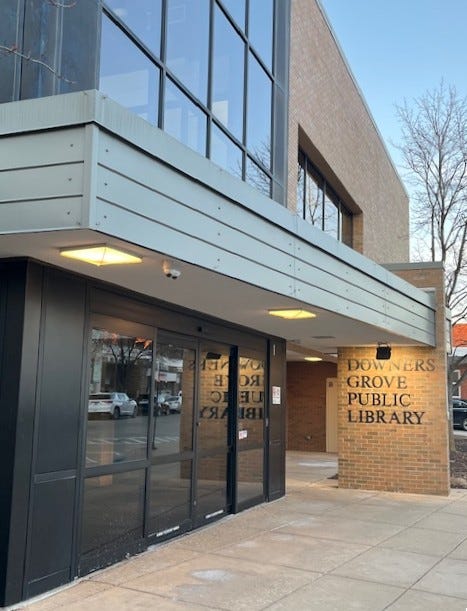
At the heart of the discussion is our highly rated and locally esteemed Downers Grove Public Library. A municipal library in a village that operates under the managerial form of government, DGPL is overseen by six trustees who are appointed by the mayor with the approval of the Village Council. They are entrusted with the authority to set the library’s tax levy, which is then approved by the council as part of the village’s annual budget.
In this, DGPL is unique among municipal libraries in Illinois, the Joint Ad Hoc Committee learned. All other villages operating under the managerial form of government have seven-member elected boards, according to the draft report. Six-member appointed library boards are found under the commission form of village government, which Downers Grove abandoned in favor of managerial government following a 1962 referendum. No one apparently knows why the village failed to transition the library to an elected seven-member board in response to that change.
Under state law, DGPL can continue to operate as a municipal library—although it’s unclear whether it would need to add a seventh trustee or whether it could continue to have an appointed board.
The other option would be to convert to a public library district. There are two ways to affect that change. A petition would need to be signed by at least 10% of registered Downers Grove voters or ordinances would need to be passed by both the Library Board of Trustees and Village Council, and then finalized in court. The new library district’s initial board members would be appointed by the DuPage County Board chairman, with the advice and consent of the County Board. They would serve only until elected trustees could be seated.
According to the draft report, district library conversions usually are undertaken to increase a library’s service area, as in a rural or underserved areas, or to ensure future funding by broadening the tax base. Neither of these circumstances appear relevant to Downers Grove.
A third governance option, referred to as “the hybrid model,” was developed for the Aurora Public Library but never implemented. It called for the library to remain a city library with a nine-member appointed board, but provided the option to convert to an elected board by referendum via either city ordinance or a petition signed by 10% of voters.
At the time the model was introduced, “there was a lot of frustration and disappointment and anger with the board,” said Joe Filapek, associate director of Reaching Across Illinois Library System (RAILS) and board president of the Aurora Public Library District. He was interviewed by the Joint Ad Hoc Committee along with another expert in library governance, John Chrastka, founder and executive director of EveryLibrary.
The hybrid model was embroiled in politics from the start, with state legislators pushing it forward despite opposition from the Illinois Library Association and Aurora officials, who immediately opposed the bill. The hybrid model of governance has never been used in Illinois.
Instead, Aurora converted to a library district in 2022, largely as a means to generate more revenue. The process included “many, many attorneys, financial advisers, obviously our own staff, obviously those on the council end and their staff,” Filapek said. Costs associated with the conversion ranged to $200,000, “and then you think about things that maybe the city has been paying for—payroll, accounting software, all those things where we had to hire at least one additional staff, maybe two.”
“I would never advise a library to become a district simply because they wanted an elected board,” Filapek said.
Other Outtakes From the Draft Report
To date, interviews and research have led the committee to conclude that the fundamental attributes of appointed and elected boards are virtually the same, with the ability of elected boards to levy taxes as the only material difference. For both types of boards, effective governance relies heavily on providing board members with training, education and a strong understanding of library law and constitutional principles as well as an understanding of the challenges, responsibilities and confidentiality required of them. Finally, board members must recognize the legal and ethical requirements of their oath of office and take it seriously, according to the draft report.
Appointed board members are subject to the body that appoints them, which in Downers Grove is the Village Council. Within the last decade, the council has seen fit to remove two trustees from the Library Board. In contrast, “there is no impeachment of elected library board members in Illinois,” Chrastka told the Joint Ad Hoc Committee.
Elected library board seats can be difficult to fill. There were only five candidates for seven open seats when the Aurora library was converted to an elected board, Filapek said. The two remaining seats in this town of 200,000 were filled by write-in candidates. Since then, candidates have been more numerous. However, in the aftermath of the 2025 election, Filapek looked at the results in three of the five collar counties. “Looking at 63 library elections, 42 of those elections were uncontested,” he said.
Neither elections nor appointments are guaranteed to enhance a board’s diversity. Filapek noted that the Aurora board became slightly less diverse immediately after the conversion, adding that appointed boards have a more direct path to achieving diversity.
Elected officials, generally speaking, are motivated by either “people, place or platform” to run for office, Chrastka said. “People is not voters. People is ‘my people,’ and sometimes that is driven by demographics, sometimes it’s driven by origin and sometimes it’s driven by community detention and development over time.“Platform is when somebody says, ‘I’m going to run to fix or do or clean up or enact.’ So, the self-identified person wants to run for office as a representative of either people, place or platform.”
Both elected and appointed boards can be subject to political pressure. “There are factors which appear to affect the performance of boards to a greater extent than whether they are elected or appointed,” Chrastka said.
Filapek noted that “with appointed boards, you have government officials that may be utilizing political appointments as a way to sort of extend some kind of agenda. But with an elected board, of course, you can have factions, you can have slates that run with a particular agenda.”
There is virtually no scholarly research on the suject of elected versus appointed public library boards. However, the Joint Ad Hoc Committee was able to review studies that contrasted other elected/appointed officeholders, including state judges, city treasurers, election administrators and school board members.
There is much more to be gleaned from the 77-page Draft Report, and readers are encouraged to peruse it. Also, stayed tuned for a timeline of the events that led to the formation of the Joint Ad Hoc Committee of the Downers Grove Village Council and Downers Grove Library Board of Trustees.